Years after high school chemistry left me discouraged, I gave myself a second chance and changed the way I saw myself as a learner.
Most of us have a subject we gave up on.
Maybe it was math. Maybe it was a foreign language, music theory, coding, art or writing. For me, it was chemistry.
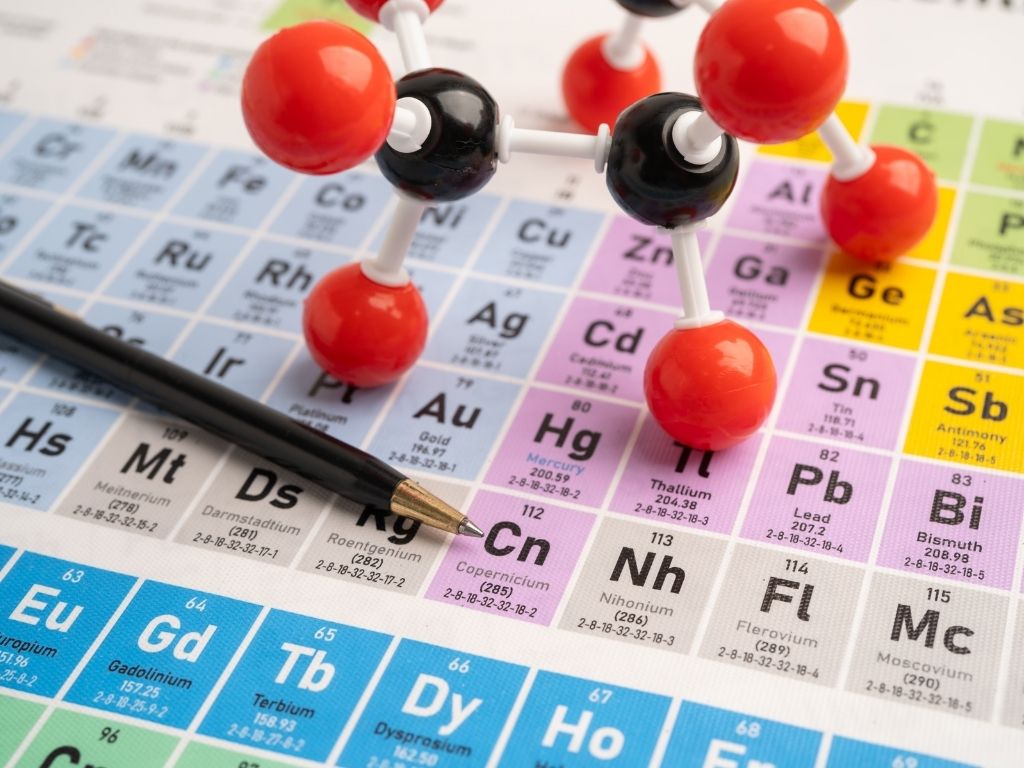
In high school, I walked into Honors Chemistry excited to mix chemicals in glass beakers and watch the reactions fizz and bubble or maybe even explode. The periodic table stretched across our classroom wall like a code to the universe. I wanted to know what those elements could reveal about the world.
And then the class started. That excitement faded pretty quickly. I remember staring at chemical equations and feeling like everyone else had received an instruction manual that I somehow missed. After barely passing the class, I filed chemistry away as one of those subjects I just wasn’t good at.
For years, that was the story I carried with me: I’m not a science person.
But one of the best parts of lifelong learning is that we can revisit old stories. We can return to subjects that once made us feel defeated and ask a new question: What if I tried this differently?
Learning Project Overview
This year, as part of my effort to strengthen my science literacy, I decided I wanted a chemistry do-over.
This time around, I wasn’t trying to recreate my high school chemistry class with its complex formulas and high-stakes exams. My goal was different. I wanted to understand the big ideas and how they show up in everyday life. I wanted to be able to follow science news, make sense of product labels and better understand health information and environmental issues.
More than anything, I wanted to change the story and prove to myself that I could learn science with the right strategies, a clear purpose and the willingness to try again.
Here is what helped.
1. Start With the Right Goal
One of the most important decisions in any self-directed learning project is choosing the right goal. If your goal is too broad, you can get overwhelmed. If your goal doesn’t match your purpose, you may end up studying material that doesn’t serve you.
My goal to improve my science literacy meant I needed to understand the general principles, not to become an expert in chemistry. Since I wasn’t preparing for a test, I didn’t need to focus heavily on advanced math or isolated facts. Instead, I needed resources that explained concepts clearly and connected them to daily life.
If you are returning to a subject that once overwhelmed you, this is a good place to start. Ask yourself:
- What do I want to understand?
- How will I use this knowledge?
- What level of mastery do I need?
You may not need to learn everything. You may just need a better foundation.
2. Choose Materials That Match Your Purpose
Once I knew my goal, I chose materials that supported it. I used two primary resources:
“Chemistry and Our Universe: How It All Works” from The Great Courses
The Chemistry and Our Universe video series from The Great Courses offers an introduction to chemistry through 60 half-hour lectures taught by Professor Ron B. Davis, a research chemist at Georgetown University. It is designed for both lifelong learners who do not have a strong foundation in chemistry and students preparing to take general chemistry in college.
The course covers a year’s worth of introductory college chemistry, but it does more than explain concepts and formulas. It also includes fascinating stories about the history of chemistry, some of the eccentric scientists who pioneered the field and the many ways chemistry shapes our everyday experiences.
The series also features a variety of fun and engaging lab demonstrations. That was especially helpful for me as a lifelong learner without access to a lab. Seeing reactions and models in action helped reinforce the concepts and made the material easier to understand. Plus, who doesn’t love a good explosion once in a while?
“Chemistry for Dummies All-in-One”
By Christopher R. Hren, John T. Moore and Peter J. Mikulecky
Chemistry for Dummies All-in-One explains general chemistry concepts in a clear, approachable way. I chose it because the practice problems kept me actively engaged with each concept, instead of simply reading or watching videos. The chapter quizzes also helped me check whether I understood the main ideas before moving on.
In addition to these resources, I read several general-audience books about everyday chemistry. These helped me build background knowledge and see chemistry in action, from the reactions involved in cooking to the reason ice floats in water. Check out my chemistry reading list here.
3. Turn Big Ideas Into “I Can” Statements
Chemistry can quickly become overwhelming because there is so much to learn. To stay focused on the concepts that would do the most to build my science literacy, I created “I Can” statements for the major topics I wanted to understand.
An “I Can” statement is a short sentence that describes what you should be able to know, understand or do after learning something. For example:
- I can explain the difference between an atom, an element, a molecule and a compound.
- I can explain how the periodic table is organized.
- I can explain the difference between ionic, covalent and metallic bonding.
These statements gave me a clear target. Before I watched a lecture or read a chapter, I knew what I was trying to understand. Afterward, I could use the statement as a self-check.
- Could I explain the concept in my own words?
- Could I recognize it in an example?
- Could I connect it to everyday life?
If the answer was no, I knew I needed to go back and review. This strategy helped me study with more intention. It also helped me see progress. Instead of measuring my learning by how much chemistry I still did not know, I could see what I was beginning to understand.
When you return to a subject that once made you feel defeated, small signs of progress can help you stay motivated. For more on this process, read How to Set Better Learning Goals With “I Can” Statements.
4. Use AI as a Study Partner, Not a Shortcut
The world of studying has changed a lot since my high school days of poring over a chemistry textbook. In addition to building my science literacy, I wanted to explore how AI could support my learning goals.
For this learning project, I tested NotebookLM, Google’s AI-powered research and note-taking assistant. NotebookLM is organized around “notebooks.” Each notebook is like a separate workspace for a topic or project. Inside that notebook, you add your own sources, such as documents, websites, audio files, videos and notes. Then NotebookLM uses those sources to help you summarize, study and ask questions about the material.
That makes it different from a general chatbot. Instead of asking broad questions and getting answers from the open web or the model’s general knowledge, you are working from a set of materials you choose. NotebookLM pulls its responses directly from your source materials and includes citations to relevant passages, which makes it easier to check the accuracy of the information.
For my chemistry project, I created a chemistry notebook and added the Chemistry and Our Universe guidebook, links to some helpful Khan Academy chemistry videos and my “I Can” statements. This gave me one organized place to connect what I was studying with the goals I had set for myself.
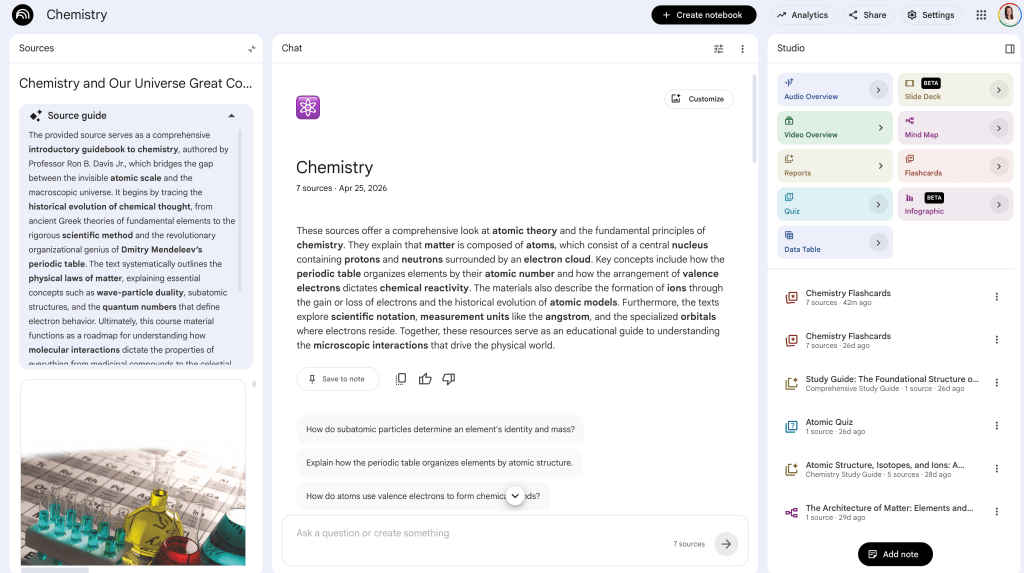
From there, I used NotebookLM to make studying more active. I asked it to generate study guides, flashcards and quizzes based on my materials. I could tell it to focus on one chapter, combine several topics or adjust the difficulty level. When I missed a quiz question, it gave me feedback and explanations that helped me review the concept.
Another fun feature I tried was NotebookLM’s Audio Overview tool, which turns source material into a conversational audio summary. I used it to create a podcast about molecular geometry, with two hosts walking listeners through VSEPR theory in clear, accessible language. It was both fun and useful, and I could keep learning while getting some laundry done.
AI did not replace the work of learning. I still had to read, work through practice problems and memorize vocabulary terms. But it made the process more interactive and easier to personalize.
5. Connect the Subject to Your Life
The more I learned, the less chemistry felt like a class I had failed and the more it became a lens for understanding the world. I started seeing it in the kitchen, in the grocery store and in the products on my bathroom counter. I noticed it when reading about health, climate, food, energy and technology.
My kids and I also tried a simple kitchen chemistry experiment by making color-changing lemonade. The recipe uses butterfly pea flower tea, which acts as a pH indicator and changes from blue to magenta when it comes in contact with an acid, such as lemon juice.

It was a fun way to experience the magic of chemistry. And teaching my kids about indicators and how they work helped reinforce the concept for me, too. If you’re interested in trying this at home, here’s the recipe for color-changing lemonade.
The more I connected chemistry to daily life, the more meaningful it became. It was no longer just a set of equations and abstract concepts. I was living it.
What This Project Taught Me
This chemistry project changed the way I think about learning difficult subjects. Chemistry did not suddenly become easy. I still had to work through plenty of confusion. But this time, I had a system with a clear purpose, relevant materials and strategies for keeping learning active and engaging.
Most importantly, I stopped treating struggle as proof that I could not learn chemistry. Struggle is part of learning. And it’s often necessary before you reach a new level of understanding.
I started this project because I wanted to improve my science literacy. But it offered something greater – the chance to rewrite an old story about myself. This time, I discovered that chemistry could be joyful after all.








Leave a Reply