Explore the transformative power of learning projects that ignite curiosity and enrich your life through intentional exploration.

At the heart of Project: Dabble is the belief that curiosity deserves space in our adult lives, not just in passing moments, but through intentional exploration in the form of learning projects.
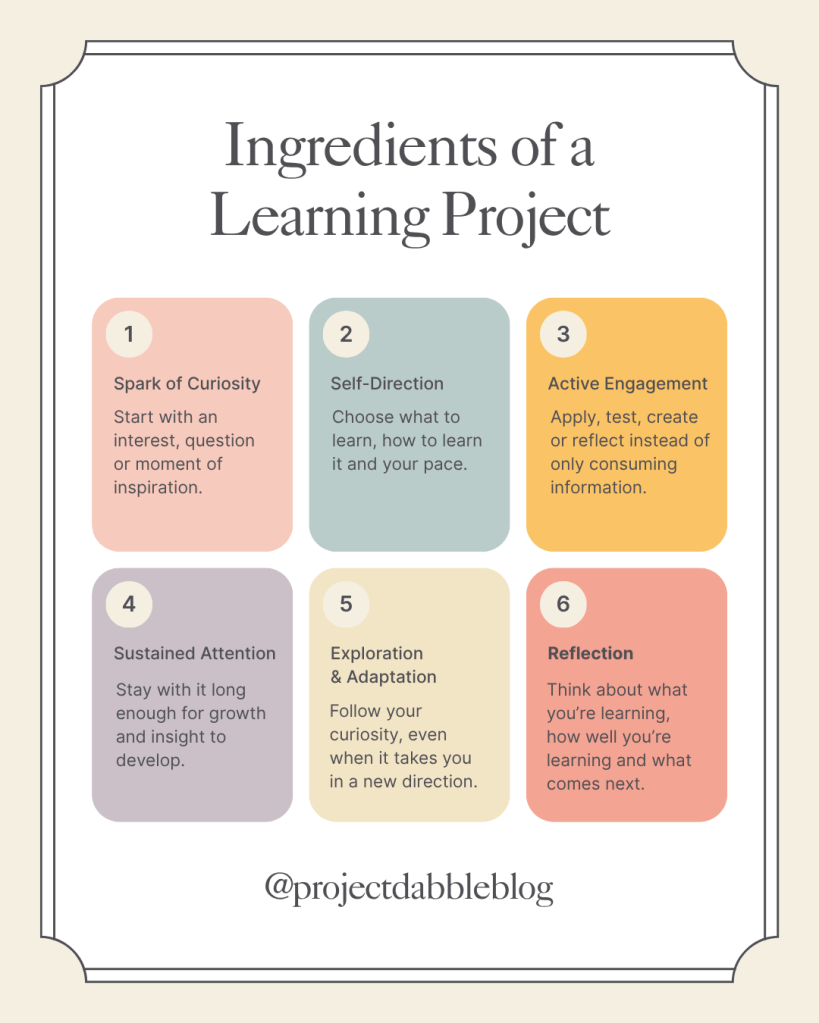
A learning project is a self-directed exploration centered on a skill, topic, or interest. It usually begins with a spark of curiosity and unfolds as you follow that interest over time, experimenting, reflecting, adapting, and continuing to learn.
Learning projects don’t have to be big or formal. Some of mine have been structured, such as joining Toastmasters to improve my public speaking skills. Others have been informal. For example, my kids and I enjoyed reading books about cryptography and leaving secret messages around the house.
They also don’t necessarily lead to mastery. In fact, learning projects often feel more like play than pressure. You may follow a thread of curiosity and realize it’s not for you, or you may learn just enough to feel satisfied and move on.
On the other hand, what begins as a learning project can evolve into a long-term passion. My interest in helping my children develop their language and literacy skills as preschoolers inspired me to go back to school, earn my teaching license, and change careers into the field of education.
So why define this term? Partly to clarify what kinds of stories and experiments you’ll find on this blog, but also to help you recognize the value of your own curiosity. Many of us are already dabbling without realizing it. Naming and framing these experiences as learning projects helps us see them as worthwhile, even when they don’t lead to external rewards or career advancement.
The Value of Learning Projects
Learning projects enrich our lives in quiet but powerful ways. They help us:
- Stay curious in a world that often rewards efficiency over exploration.
- Build self-efficacy by showing we can stretch and adapt to new challenges.
- Connect more deeply with others, especially when we share what we’re learning.
- Make time for joy, play, and personal growth, even amid daily responsibilities.
You don’t need to become an expert to benefit from a learning project. In fact, trying something you’re not good at can be the most transformative part.
What Learning Projects Aren’t
Learning projects aren’t about productivity, performance, or expertise. They aren’t tasks you do because you have to. And they’re not one-off efforts that start and stop with a single step.
A learning project is more than watching a video tutorial or Googling a fact. It’s also not about completing something for external validation. Rather, learning projects are driven by your internal motivation to explore and grow, even if you’re the only one who notices.
Here’s where it gets fuzzy: almost anything could be a learning project. A sourdough bread recipe can be a learning project, or just a snack. It’s the mindset you bring to it.
Examples of Learning Projects
- Joining a local choir to learn music theory and improve your vocal technique.
- Reading several books about the history of World War I and reflecting on what you learn.
- Experimenting with watercolor painting by watching tutorials and practicing weekly.
- Learning to code by building a basic website.
- Creating a pollinator garden, researching native plants, and observing changes over time.
- Exploring astronomy with your kids by reading space books and stargazing with a telescope.
- Writing a blog about local architecture as you learn about styles and history.
Non-Examples of Learning Projects
- Skimming a single article about meditation and moving on.
- Watching a documentary series passively without further reflection or engagement.
- Helping a child with homework once, without taking interest in the topic.
- Quickly looking something up and forgetting it five minutes later.
- Attending a professional development workshop because it’s required, with no follow-up.
These might be learning moments, but they don’t rise to the level of a project unless they spark further action, reflection, or sustained curiosity.
What About Projects That Are Task-Driven?
Not everything that involves research and decision-making is a learning project in the spirit of this blog. Some tasks, like buying a car or planning a trip, certainly involve learning. You might compare options, read reviews, talk to people, and make informed choices. That process is self-directed and often quite involved.
But for the purposes of Project: Dabble, I draw a line between task-based learning and curiosity-driven exploration.
If you’re researching something because you need to make a decision, that can be meaningful and even life-enhancing, but not necessarily the kind of learning project I highlight here.
That said, these tasks can spark learning projects if your curiosity expands beyond the immediate need. For example:
- Buying a car might lead you to explore the future of electric vehicles.
- Planning a trip might inspire you to study the history, language, or cultural traditions of the place you’re visiting.
When learning moves beyond just getting it done and becomes something you want to pursue out of genuine interest, that’s when it becomes a learning project.
FAQs About Learning Projects
Q: Do I need to finish something for it to “count”?
Nope. Many learning projects never reach a formal end. They evolve, pause, or fade out. Completion isn’t the goal; engagement is.
Q: Do learning projects have to be expensive?
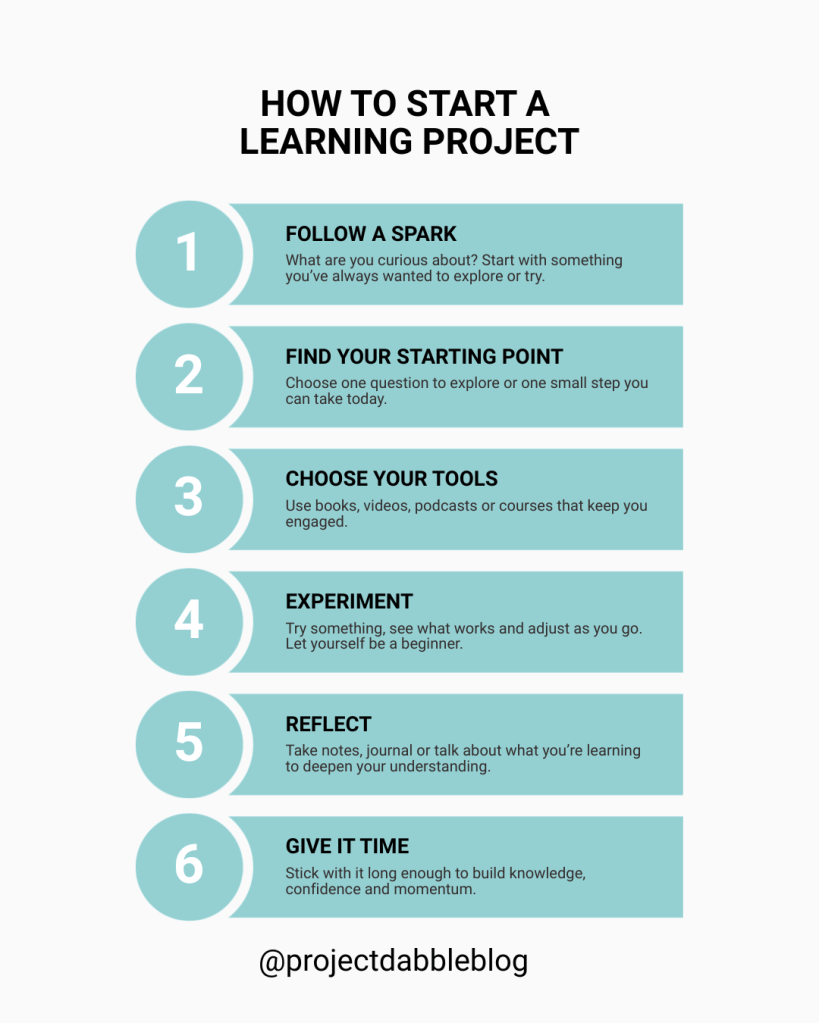
Not at all. Learning projects do not have to involve signing up for pricey classes or buying lots of materials. In fact, many of the projects featured on this blog rely on free or low-cost resources, including library books, podcasts, YouTube tutorials, public events, or tools you already have at home. You don’t have to spend a lot to learn a lot. I’ll be sharing plenty of free ideas and materials to help you get started.
Q: Can reading be a learning project?
Yes, if it’s part of an ongoing exploration. Reading becomes a learning project when you reflect, apply what you read, or connect it to other sources or actions.
Q: What if I change my mind halfway through?
That’s normal! Learning isn’t linear. Pivoting or dropping a project is part of the process.
Q: What if I’m not very good at it?
Even better. Learning projects are a safe place to not be good. That’s where growth happens.
Q: Does it have to be hands-on?
Not necessarily. A project can be primarily intellectual or digital, as long as you’re actively engaging, not just passively consuming.
Q: How do I know if something counts?
If it began with curiosity, kept you engaged, and led to growth or insight, it counts.
If something’s been tugging at your curiosity, why not let it grow into a learning project? Happy dabbling!








Leave a Reply