Orienteering turns a walk or run in the woods into a full-body, full-brain adventure. Here’s how the sport works, why navigating without GPS may benefit spatial memory and what beginners need to know before heading out.
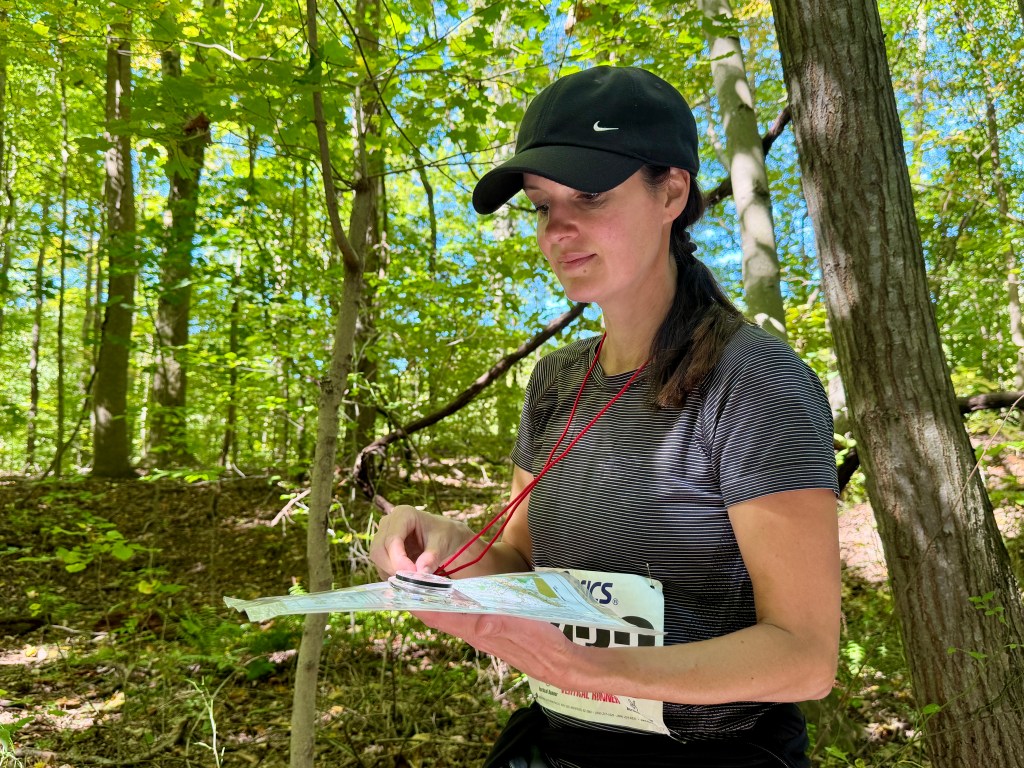
By the time we reached the junction, I had stopped trusting my sense of direction. I consulted the map again and tried to remember how many bends in the trail we had passed.
We were supposed to head north toward a marsh where the path diverged. But was this the right junction? Had my daughter and I gone far enough?
This was our first orienteering race. The course was 2.9 kilometers long, but there was no marked route to follow. Instead, there were 13 digital control points scattered throughout the dense forest, tucked behind rootstocks, positioned on spurs and nestled near stream crossings. To find them, we could use only a topographic map and compass.
A fellow orienteer noticed us puzzling over the map and stopped to help. She confirmed that we were at the correct junction, then trotted down the trail heading north.
We were about to follow when my daughter looked up at me, her face suddenly serious.
“I can’t find the e-punch,” she said. “I must have dropped it.”
The small electronic device, worn on your finger, records your progress by registering each control point you reach. Without it, there would be no record that we had completed the course. Somewhere between here and the previous control point, it had slipped off her finger.
We would have to retrace our steps through the woods.
A New Adventure
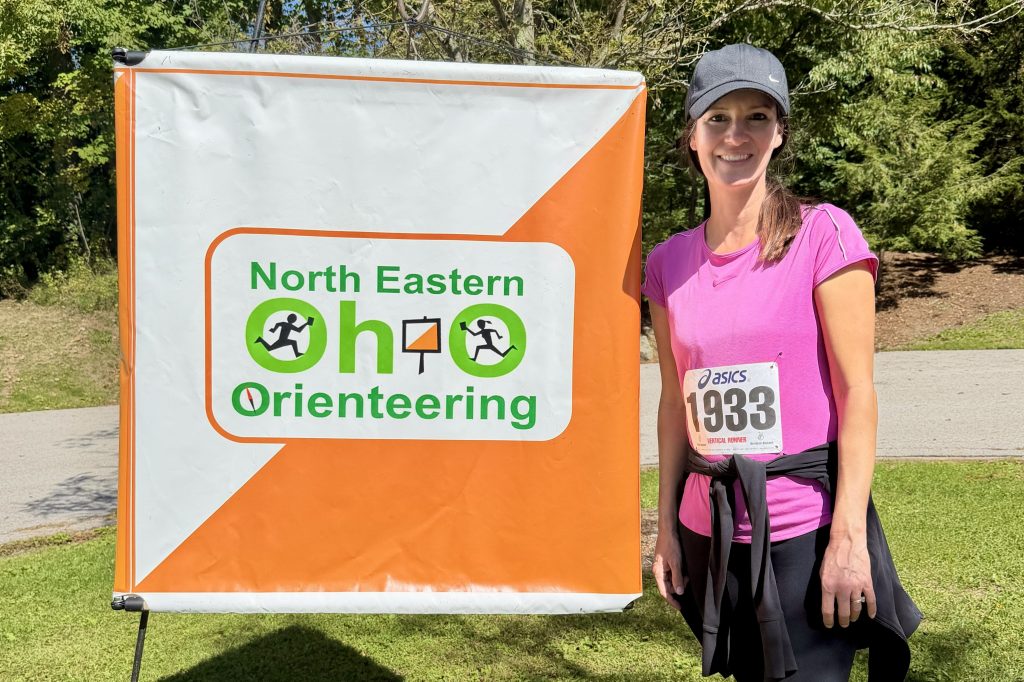
I’ve always loved dabbling in new ways to stay fit. Looking for a fun way to shake up my running routine, I decided to give orienteering a try. The sport combines hiking and running with navigation, problem-solving and exploration. My 11-year-old daughter was game, so we headed to Big Creek Park for the 2026 Masters Nationals, hosted by the Northeast Ohio Orienteering Club from Sept. 25-27.
Hundreds of athletes from across the United States traveled to Cleveland for the national competition. The event also offered recreational courses for beginners like us. At check-in, organizers gave us a quick introduction to the sport, explaining the map symbols, how to use a compass and how to navigate from one control point to the next.
After years of relying on GPS, my map-reading muscles felt flabby and my overall sense of direction had grown rusty. And that, it turns out, may be part of what makes orienteering so valuable.
A growing body of research suggests that navigating through unfamiliar terrain can strengthen our spatial memory, the brain’s ability to understand where we are, remember routes and build mental maps of the world around us. These skills rely heavily on the hippocampus, a seahorse-shaped region of the brain involved in memory, learning and navigation.
Getting a little lost may actually be good for us.
What is orienteering?
Orienteering is an international competitive sport that combines racing with navigation using a topographic map and compass. Participants navigate through unfamiliar terrain to a series of control points, choosing their own route from one to the next.
The fastest path is not always the most direct one. An orienteer might follow a trail around a hill, cut through the woods on a compass bearing or use a stream, ridge or other landscape feature to stay oriented.
Detailed topographic maps help orienteers plan their route. Specialized symbols show trails, rock formations, streams, marshes, vegetation boundaries, buildings and subtle changes in the terrain. Learning to read those features and match them to the landscape is a central part of the sport.
Most events offer courses ranging from beginner to expert. Beginners can often participate recreationally rather than racing for a competitive time. And while experienced orienteers may run much of the course, there is no requirement to do so. You can walk, jog or combine the two. This makes it a great sport for families and people with a wide range of fitness levels.
Events are held throughout the year. Foot orienteering is the most common form, but variations of the sport also take place on skis, mountain bikes and even in canoes.
Orienteering originated in Scandinavia in the late 19th century as a military training exercise in land navigation. One of the earliest competitive events for Swedish military officers was held in 1893, followed by a civilian competition in Norway in 1897.
The sport grew in popularity during the 20th century, aided by improvements in compass design, and remains especially popular in Scandinavia. In Sweden and Finland, orienteering skills are also taught as part of physical education.
Norwegian Harald Wibye helped introduce orienteering to the United States, where one of the first events was held at Valley Forge, Pennsylvania, in 1967. Today, Orienteering USA is the national governing body for the sport in the United States and offers beginner resources, an event calendar and information about local clubs.
Why Getting Lost Is Good for You
GPS makes getting from point A to point B easier than ever. But relying on turn-by-turn directions comes with a tradeoff. Following the blue arrow gives our brains less practice using spatial memory, the internal navigation system that helps us track distances, directions and landmarks.
Spatial memory relies on the hippocampus, a brain region involved in learning and memory. Research has linked greater reliance on passive navigation with poorer spatial memory and a smaller hippocampus, prompting scientists to study activities that keep the brain’s navigation system engaged.
Scientists at McMaster University found that a single session of orienteering improved spatial memory and boosted levels of brain-derived neurotrophic factor, or BDNF, a key neurochemical involved in brain plasticity. The combination of physical and mental stimulation appeared to provide benefits beyond those of physical exercise alone.
The researchers suggest that orienteering may give the hippocampus a particularly rich workout because it combines physical exertion with active navigation. Participants must observe their surroundings, make decisions, form mental maps and correct navigational errors while moving.
Tips for Getting Started
Orienteering is easy to try, but a little preparation can make your first outing both fun and safe.
Find your local orienteering club.
Local clubs are one of the best places to start. Many offer beginner instruction, practice events and recreational courses, along with a community of experienced orienteers who can help you learn the basics. Orienteering USA maintains a directory of clubs and events around the country.
Bring a buddy or form a team.
Orienteering is more fun when you have someone along for the adventure. Having a companion gives you another set of eyes to interpret the map, spot landmarks and talk through route choices. And when you make a wrong turn or finally find a control you’ve been searching for, you have someone there to laugh or celebrate with.
Know what to bring.
Orienteering doesn’t require much specialized gear. Wear comfortable walking or running shoes and weather-appropriate clothing. Long pants are a good idea because some routes may take you off trail.
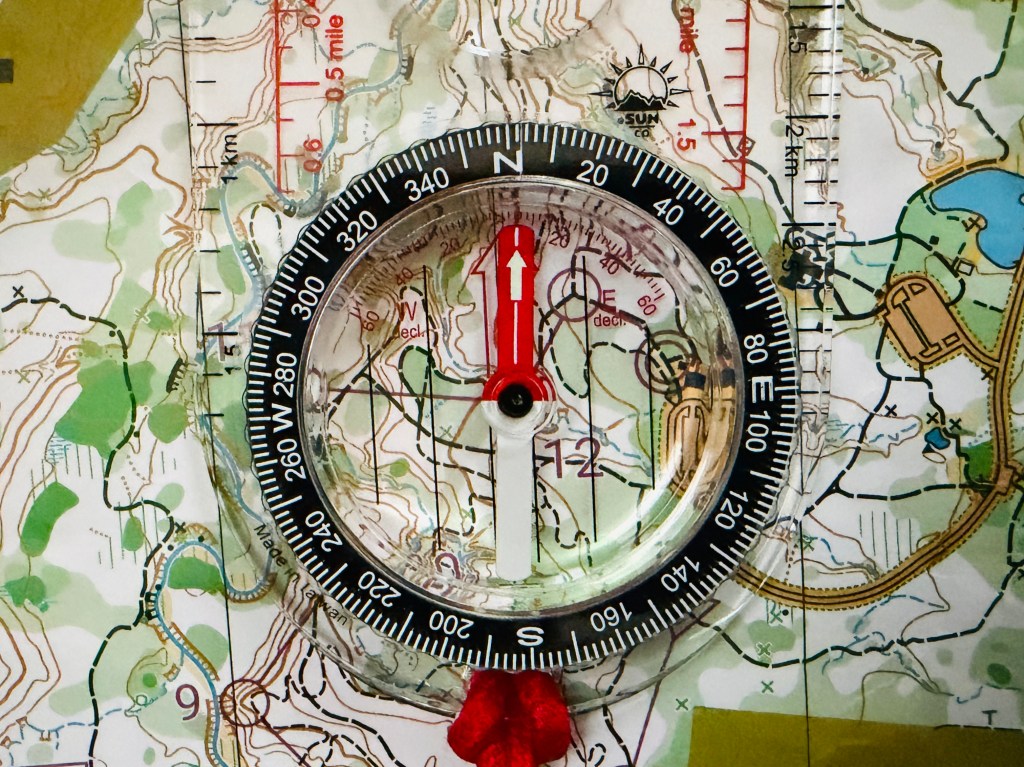
You’ll also need a compass. A baseplate compass has a clear rectangular base that can be laid directly on the map, making it useful for beginners who are learning to take bearings and orient the map. A thumb compass attaches to your thumb, allowing you to hold the compass and map together while moving, and is popular with more experienced orienteers.
Bring water, snacks and basic safety equipment such as an emergency whistle, a fully charged phone and a small first-aid kit. You may expect to spend only an hour on the course, but it can take considerably longer if you get turned around or have trouble finding a control. And don’t forget your sense of adventure.
Arrive early.
Orienteering events often use staggered starts, with participants beginning at different times during a designated start window. This helps ensure that each person or team navigates the course independently rather than simply following the pack.
For our first event, starting early gave us plenty of time to ask questions before heading out and get comfortable with the process. It also meant there were plenty of other participants on the trail when we got turned around or needed guidance. We found experienced orienteers friendly and eager to help beginners.
Enjoy the scenery.
It’s easy to become so focused on finding the next control or watching the clock that you forget to look around. Our courses took us along pine-scented trails, beside streams, through marshes and meadows, and past rocky overlooks. Enjoying the landscape is one of the best parts of the sport.
Finding Our Way
As we retraced our steps in search of the missing e-punch, I tried to reassure my daughter. We were outside on a beautiful day, we were together and this was all part of the adventure.
We scanned the trail and surrounding brush as we made our way back toward the previous control point, which was tucked off-trail near a fallen tree. Still no e-punch.
I said a silent prayer to St. Anthony, the patron saint of lost things, then told my daughter we might have to finish the course without the e-punch. She looked down at the trail and sighed.
I turned to scan the area one last time. A red strap peeked out from the leaf litter.
There it was.
We scooped up the e-punch with a whoop of joy. Without missing a beat, we sprinted toward the next control point, relieved and ready to find our way out of the woods.








Leave a comment